
JMatPro®
JMatPro® API
Add-On
The JMatPro® API (Application Programming Interface) can be used to incorporate specific functionality of the JMatPro® software into your own applications. We provide the basic building blocks for you to automate and develop tasks within your own models and to integrate them into your own software.
Full Details
The JMatPro® API provides calculations for:
- Stable and metastable phase equilibria
- Physical and thermophysical properties
- Solidification phases and properties
- Time-temperature transformation (TTT) diagrams
- Continuous cooling transformation (CCT) diagrams
- Mechanical properties for Al, Mg, Fe, Ni, Co, Ti and Cu alloys
For General Steels and Titanium alloys:
- Cooling properties in the solid state
For Nickel and Nickel-Iron based superalloys:
- Microstructure and strength after heat treatment
Benefits of using the JMatPro® API
The JMatPro® API is a collection of functions, organised in several libraries written in C/C++, that allow you to integrate some of the functionality of JMatPro® into your own applications. It gives you the flexibility to write code tailored for your specific needs, including but not limited to:
- Development of custom models
- Task automation / batch data generation
- Creation of custom export files for third-party simulation software
- Streamlining materials / process simulation workflows
The API comes with thorough documentation and plenty of code samples to help you get started. A full Python wrapper and demo code are also available.
Resources
JMatPro® API reference guide
*If the API documentation does not open properly or if some of its content seems to be missing: right click on the chm file, select 'Properties', then click 'Unblock', press OK and try to open the chm file again*
VERSION 10.0.5 (May 2026)
• Improved robustness of backtracking procedure in Scheil-Gulliver calculations to handle steps where the calculation of phases fails to converge.
VERSION 10.0 (January 2026)
• Extended back diffusion calculations in the Solver and Solidification modules to consider user-defined cooling profiles.
• Extended the calculation of room-temperature matrix mechanical properties in Coldfire for magnesium and copper alloys.
• Extended Mechanical module for cast magnesium alloys, including the calculation of room-temperature and high-temperature strength, as well as flow stress curves.
• Extended Mechanical module for copper alloys, including the calculation of high-temperature strength and flow stress curves.
• Extended high-temperature strength and flow stress calculations in the Mechanical module for titanium alloys in the tempered condition.
• Extended the calculation of tempered hardness to consider general steels of quenched microstructure.
• Added time to the output of back diffusion calculations in the Solver and Solidification modules.
• Added the option of toggling phase boundaries search in Solidification calculations using the quench from equilibrium model, via the Solver function jmpSetPhaseBoundariesSearch().
• Added function to define the casting cooling rate used in Mechanical calculations for cast aluminium and magnesium alloys.
• Improved robustness of Scheil-Gulliver calculations with and without back diffusion.
• Improved Solidification and Cooling calculations for general steels and titanium alloys.
• Improved high-temperature strength calculations for aluminium alloys.
• Updated the thermodynamic and properties databases to match those included in JMatPro v16.0.
• Added Ta and B to stainless steels.
• Added Co and S to copper alloys.
• Added BN, M3B2, MB2_C32, CR2B, FE2B, and FE3B phases to stainless steel thermodynamic database.
• Added CO_HCP, CO_FCC, and CU2S phases to Cu thermodynamic database.
• Adjusted physical properties databases.
• Fixed possible failure in Cooling calculations when setting multiple constant cooling rates.
• Fixed possible issue in Cooling calculations for general steels with user-defined cooling profiles.
• Fixed possible issue in Cooling calculations for fully martensitic titanium alloys.
• Fixed possible issue in the high-temperature strength of tempered general steels with lean compositions.
• Fixed possible issues in strength calculations for aluminium alloys.
• Fixed possible failure in creep calculations for nickel alloys and addressed inconsistency issues with rupture calculations.
• Fixed possible failure in Heat Treatment calculations for nickel and nickel-iron based superalloys.
• Fixed small inconsistencies in TTT calculations for general steels.
• Fixed small renormalisation issues for titanium and copper alloys when secondary phases are present.
VERSION 9.1
- Extended TTT and CCT modules for stainless steels, nickel and nickel-iron based superalloys, single crystals, as well as aluminium, magnesium, cobalt, titanium, and zirconium alloys
- Extended Mechanical module with the calculation of flow stress per phase for general steels
- Moved jmpSetPhasesCheck() to the Core module
- Updated Python sample code to run on version 3.12
- Fixed memory deallocation mismatch causing a crash when running sequential Solver calculations
- Fixed missing microstructure labelling causing a crash in flow stress calculations for stainless steels
- Fixed material type labelling for consistency in heat treatment calculations for nickel-iron based superalloys
VERSION 9.0
- Extended the calculation of physical, thermophysical and mechanical properties below room temperature
- Added Heat Treatment module for the calculation of microstructural evolution and room-temperature strength following heat treatment of nickel and nickel-iron based superalloys
- Added secondary phases in the calculation of CCT diagrams of general steels, including the contribution of carbides to the strength
- Extended the calibration of TTT/CCT diagrams of general steels to include shifts in bainite and martensite start temperatures
- Added atomic and weight phase fractions to the output of cooling and quench solidification calculations
- Added magnetic permeability to the output of cooling and quench solidification calculations for general steels
- Added phase boundaries search in Solidification calculations using the quench from equilibrium model
- Improved robustness of automatic extraction of austenitisation temperature in quench solidification calculations for general steels
- Extended high-temperature strength and flow stress calculations in the Mechanical module for stainless steels in the tempered condition
- Improved flow stress calculations for general steels in the tempered condition
- Extended the calculation of tempered hardness to consider general steels of martensitic, bainitic and pearlitic microstructures
- Changed high-temperature strength calculation strategy to make sure output respects user choice of maximum temperature
- Improved phase mapping to deal with hanging and labelling issues
- Changed stacking-fault energy calculation to prevent negative values
- Updated the thermodynamic and properties databases to match those included in JMatPro v15.0
- Added Nb to aluminium alloys
- Added Ti to copper alloys
- Added Si3N4 phase to Fe thermodynamic database
- Adjusted (Fe,Ni)Al phase in Fe thermodynamic database
- Added Cu4Ti and CuNiTi phases to Cu thermodynamic database
- Reassessed AlCuFeNi systems in the Cu thermodynamic database
- Adjusted Mo in LAVES phases in Ni and Co thermodynamic databases
- Adjusted Ni and Co in FCC contribution to molar volume
- Extended properties of SiC phase
- Fixed possible failure in Solidification calculations using the quench from back diffusion model for steels, when ferrite fully transforms to austenite in a single temperature step below the solidus
- Fixed possible failure in Solidification calculations for heavily alloyed titanium alloys
- Fixed possible failure in high-temperature strength calculations
Version 8.1
Implemented a more efficient algorithm to accelerate the calculation of flow stress curves.
Improved calculation of the elastic limit point in stress-strain curves.
Improved model and fixed inconsistencies in strength calculations for aluminium alloys.
Version 8.0.1
- corrected typo in parameter for mechanical properties of some Aluminium alloys
Version 8.0
- Implemented a back diffusion model for steels in the Solver and Solidification modules.
- Extended the Solidification module with a quench from back diffusion model for steels and titanium alloys, improved existing quench models, and implemented a variant of the quench from Scheil-Gulliver model for titanium alloys.
- Added specific heat and latent heat of formation for each of the austenite decomposition products to the output of a Solidification calculation using the quench from Scheil-Gulliver model for steels and white cast irons.
- Extended the Cooling module for titanium alloys.
- Extended high-temperature strength and flow stress calculations in the Mechanical module for general steels in the tempered condition.
- Improved calculation of latent heat of formation of ferrite from austenite.
- Reassessed creep for BCC phase in steels.
- Improved creep and rupture strength models for nickel-based alloys.
- Added new dislocation cutting mechanism in aluminium alloys kinetics.
- Remodelled age hardening for Al3Sc phase in aluminium alloys.
- Improved stability of the thermodynamic solver.
- Updated the thermodynamic and properties databases to match those included in JMatPro v14.0.
- Adjusted the Al thermodynamic database.
- Reassessed molar volume of Ti2Cu and Ti2Ni phases for titanium alloys.
- Fixed possible failure in aluminium strength calculations.
- Fixed possible failure in high-temperature strength calculations for general steels.
You may also be interested in:
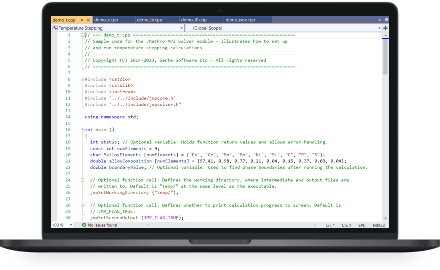
JMatPro® API
Incorporate specific functionality of the JMatPro® software into your own applications.
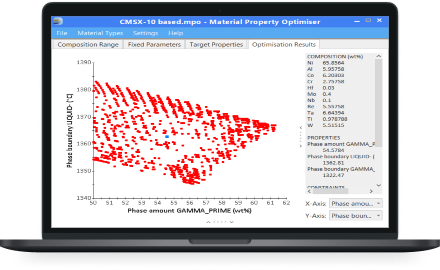
JMatPro® Material Property Optimiser (MPO)
A powerful optimisation tool for the design of multi-component alloys.